2019–present/Mobile/Completed
Interio
Scan a room, detect furniture, place pieces in AR — before you buy.
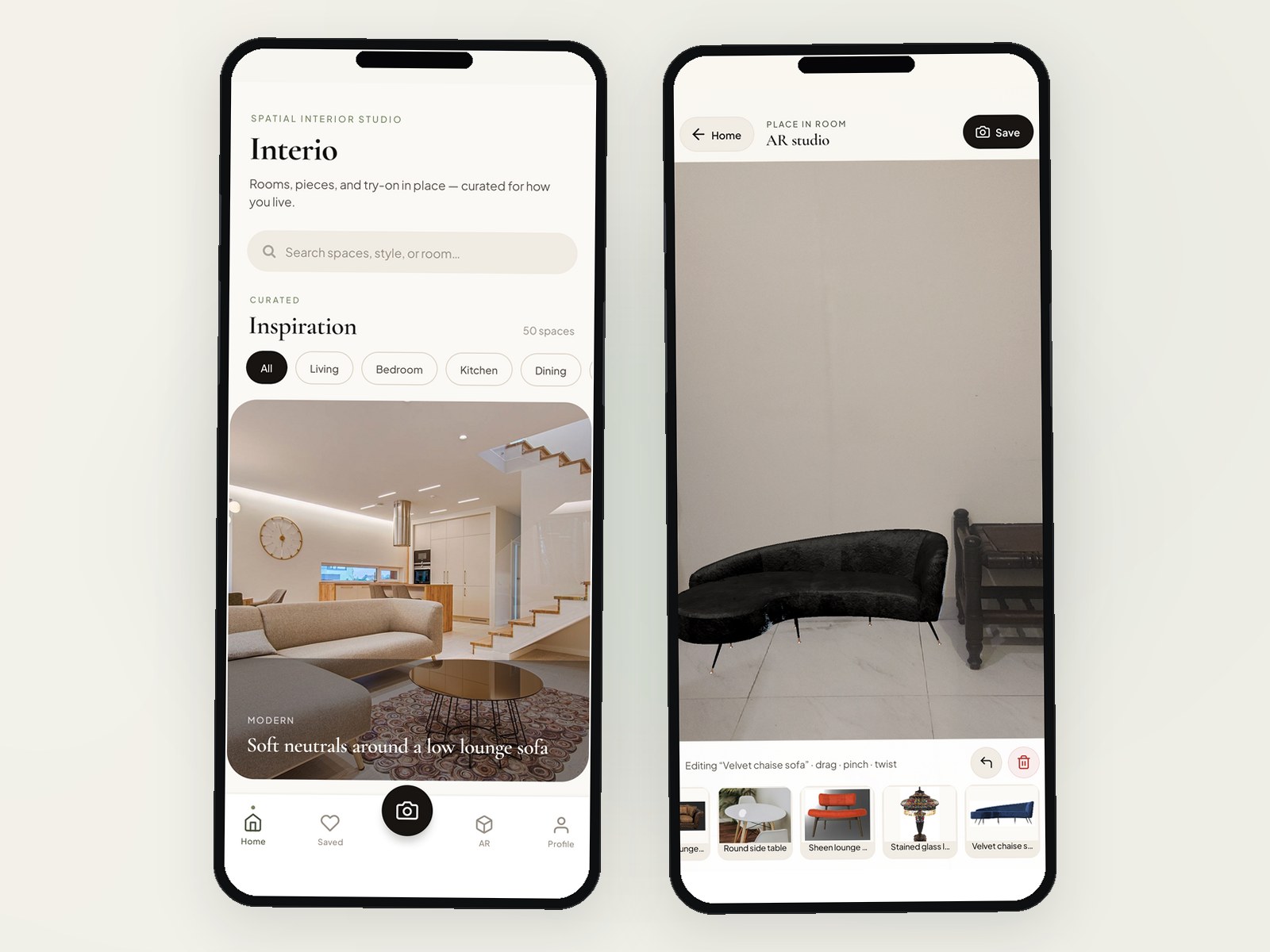
Side project that started as my 2019 FYP and that I still ship on. Expo / React Native: on-device ML Kit furniture detection, post-scan layout tips and catalogue matches, then ViroReact true-scale AR placement with drag, pinch, and twist — Firebase for auth, favourites, and catalogue.
- FYP origin · still iterating
- On-device detection → AR try-on
- True-scale GLB placement
The Problem
Buying furniture from a flat product photo is a gamble. Scale, proportion, and how a piece sits next to what you already own only become clear after delivery — when returns are expensive and rooms already feel wrong.
What I Built
Interio started as my final-year project in 2019 and is still a side project I return to. The current Expo / React Native build closes the buy-before-you-see gap in three steps:
- Scan — point the camera at a room; on-device ML Kit object detection classifies furniture (sofa, chair, table, …) with a confidence score.
- Match — a post-scan screen shows layout tips, interior inspiration for that category, and catalogue picks that complement what was detected.
- Place — ViroReact AR places true-to-scale GLB models in the live camera view — drag, pinch, and rotate until the piece feels right.
Firebase handles auth, favourites, and the furniture catalogue. Earlier FYP-era builds used TensorFlow Lite and Viro on the RN CLI stack; the 2026 Expo rewrite keeps the same product idea with a cleaner router, Zustand state, and a custom development build for camera + AR.
Major Features
- On-device furniture detection — no server round-trip for classification; labels map into catalogue types with a clear empty state when nothing is found.
- Post-scan guidance — layout tips, inspiration cards, and filtered catalogue for the detected type.
- True-scale AR studio — floor-plane placement, multi-piece editing, undo/clear, and save AR room shots to Saved.
- Catalogue + favourites — browse/search pieces; favourites sync through Firestore with local fallback.
- Inspiration feed — curated spaces on home to seed ideas before you scan.
Key Challenges
- Convincing placement — models need real-world scale and stable anchors as the camera moves; Viro’s metre-based scene plus careful default scales mattered more than fancy UI.
- On-device detection — mapping ML Kit’s generic labels into catalogue types without a backend, and recovering gracefully when nothing is detected.
- Native stack — Viro + ML Kit require a custom Expo development build (not Expo Go), New Architecture enabled, and a physical device for camera AR.
- Longevity — keeping a student FYP idea alive across RN CLI → Expo rewrites without losing the scan → suggest → place story.
Results
Shipped an end-to-end mobile flow: detection → curated suggestions → AR try-on. The product is complete as a portfolio-ready build and remains an active side project I still iterate on.
Stack Decisions
ViroReact kept AR inside React Native instead of a separate native ARKit/ARCore app. ML Kit’s on-device detector avoided shipping images to a backend for classification. Expo Router + Zustand kept navigation and scan/favourite state small enough to reason about while the native plugins did the heavy lifting.
Building something in this space?
I ship mobile, web, and AI product surfaces end-to-end — from product UI to payments and store releases.
Get in touch →