2026/AI/In Development
Decidr
Turn messy dilemmas into weighted, explainable decisions.
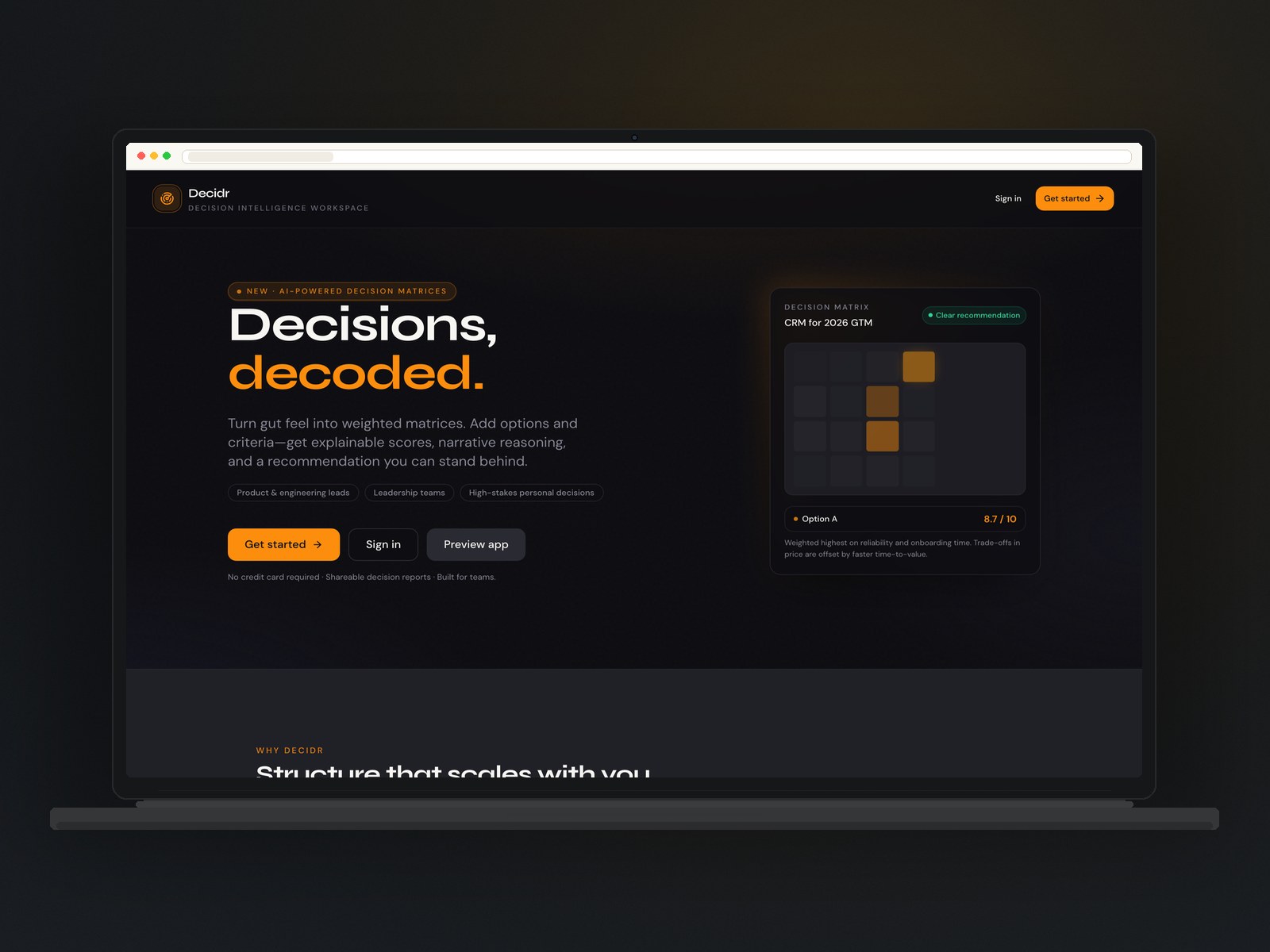
Personal SaaS: paste a dilemma or walk a wizard — options, criteria, and weights become a scored matrix with ranking, risk, confidence, and an AI reasoning trace. What-if weight simulation, side-by-side compare, share links, and Stripe Pro on Next.js + Supabase + OpenRouter.
- Weighted option × criteria matrices
- Explainable AI scoring + what-if
- Public deploy + Stripe billing
The Problem
Hard decisions rarely fail because of a lack of information — they fail because that information never gets structured into a clear comparison. Spreadsheets and chat threads bury the trade-offs; Decidr is a personal SaaS exploring whether an AI-native tool can make the structuring step feel obvious.
What I Built
Decidr turns a messy dilemma into a weighted option × criteria matrix with explainable scoring — not another chat wrapper.
- Paste a dilemma or walk a multi-step wizard (problem → options → criteria → weights).
- AI extracts options and criteria into structured JSON via OpenRouter (model-agnostic).
- Server-side ranking with risk, confidence, and a maturity score; results show ranked tables, charts, heatmaps, and an expandable reasoning trace.
- What-if weight simulation recomputes locally without another AI call; side-by-side decision compare; public share links and PDF via print.
- Email auth, Supabase data, and Stripe Pro billing on a Next.js App Router stack.
Try it live: decidr-henna.vercel.app.
Major Features
- Decision wizard — plain-text or step-by-step intake that lands in a scored matrix.
- Explainable AI scoring — ranked options with reasoning you can expand, not a black-box “pick this.”
- What-if simulation — drag weights and see rankings update without re-calling the model.
- Compare & share — side-by-side decisions and public
/d/[token]links. - Billing-ready — Stripe Pro wired for the SaaS path.
Key Challenges
Using OpenRouter instead of a single model provider means prompts and output parsing have to stay model-agnostic — structured JSON extraction has to work across vendors, not tuned to one model’s quirks. Keeping the matrix as the product surface (not a chat log) forced clear UX boundaries between AI assistance and user-owned weights.
Results
Decidr is in active development as a personal SaaS: core decision flow, charts, share links, and Stripe are in place on a public Vercel deploy.
Stack Decisions
OpenRouter avoids locking decision intelligence to one vendor’s pricing and availability. Supabase and Stripe cover auth, data, and billing without a custom backend, so product time stayed on the matrix UX and scoring pipeline rather than infrastructure.
Building something in this space?
I ship mobile, web, and AI product surfaces end-to-end — from product UI to payments and store releases.
Get in touch →